(FY2026 2nd Seminar Report) Academia Clinical Development
Tacit Knowledge and Agentic AI: Rediscovering Clinical Wisdom in the Age of Artificial Intelligence
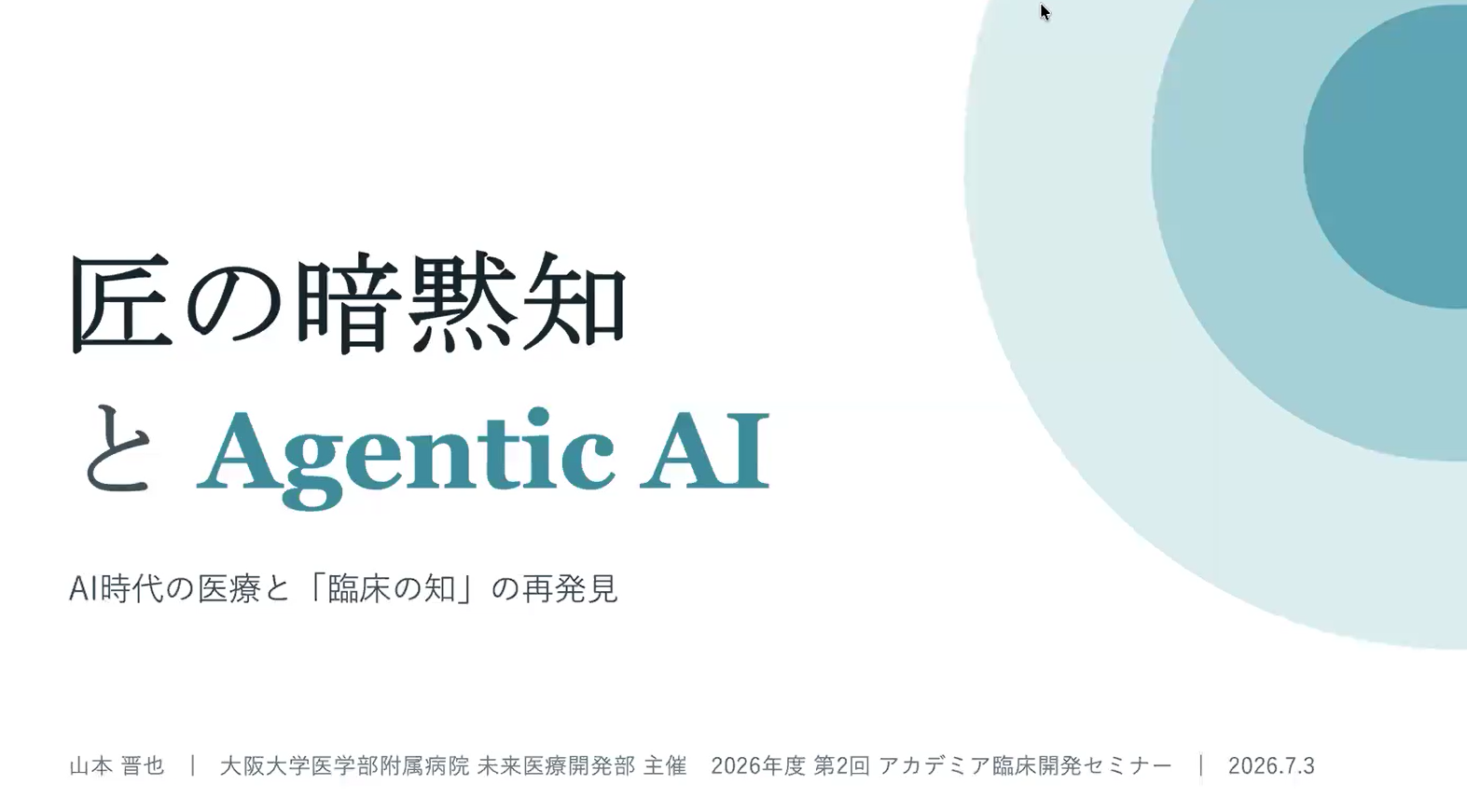
The 2nd Academia clinical research seminar was held online on July 3. We welcomed Dr. Shinya Yamamoto, Chief Executive officer of Link & Innovation, who delivered a lecture titled ‘Tacit Knowledge and Agentic AI: Rediscovering Clinical Wisdom in the Age of Artificial Intelligence.’
In his lecture, he explained how the rapid evolution of AI technology is transforming healthcare settings and how the roles of healthcare professionals are expected to evolve, drawing on practical examples.
First, he explained that AI has evolved beyond machine learning and deep learning and has entered a new phase called “Agentic AI.” Agentic AI is not limited to simply responding to instructions. It can autonomously make plans, take actions, evaluate the results, and continuously improve its performance. Therefore, he stated that we are entering an era in which people will no longer simply use AI as a tool but will work alongside it.
On the other hand, he emphasized that the more advanced AI becomes, the more valuable human beings will be. The key to this lies in “tacit knowledge.”
Tacit knowledge refers to knowledge that cannot be fully expressed through words or manuals, such as experience, intuition, and advanced skills. Because tacit knowledge is not typically documented in textbooks or academic papers, it is difficult for AI to acquire and will continue to represent a uniquely human source of value. There have already been significant changes in the medical field due to the increasing use of AI. By taking over routine and time-consuming tasks, AI enables healthcare professionals to focus more on patient care and research activities. He also stated that tacit knowledge exists not only in the medical field but also in caregiving and administrative departments. Finally, he also highlighted Japan’s strengths. Japan has accumulated world-class tacit knowledge in fields such as healthcare, manufacturing, and long-term care. However, much of this knowledge remains embedded in individuals’ experiences and has not been fully utilized. He argued that converting such tacit knowledge into explicit knowledge through the use of AI and sharing it with the world could become a new source of competitiveness for Japan. He presented a vision in which, just as Japan once led the world through its manufacturing technologies, the future will be an era in which knowledge and experience themselves are exported as valuable assets.
Our next session is scheduled for September 18, when we will welcome Dr. Hiraoka and Dr. Yamada from Gram Eye Corporation as our guest speakers. We look forward to your participation.