(FY2026 1st Seminar Report) Academia Clinical Development
Ethical Guidelines for Medical and Biological Research Involving Human Subjects
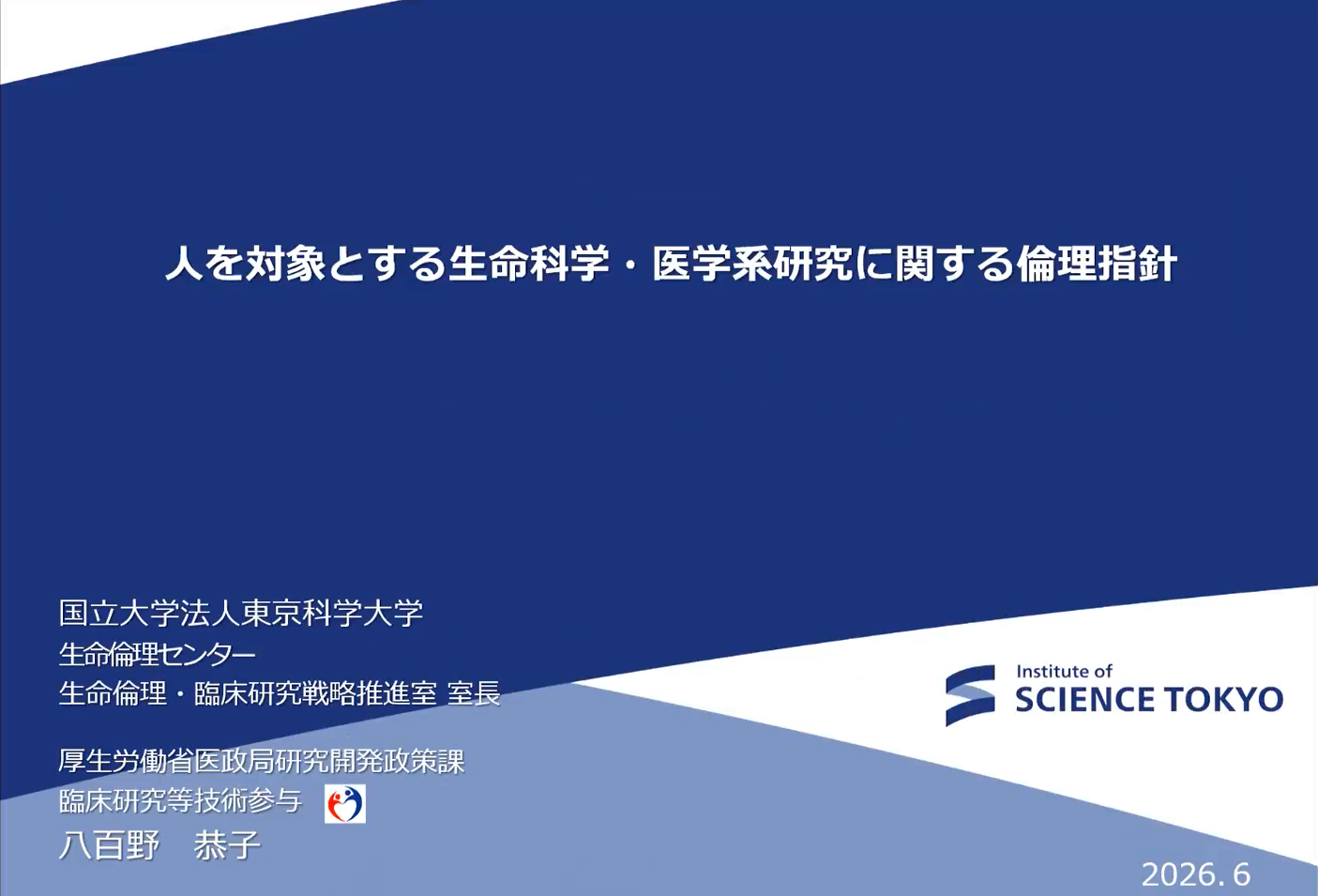
On June 26, 2026, the 1st Academia Clinical Development Seminar of FY2026 was held online. We were honored to welcome Dr. Kyoko Yaono, Director of the Office for Bioethics and Clinical Research Strategy Promotion at the Center for Bioethics, Institute of Science Tokyo, who also serves as a Clinical Research and Development Technical Advisor in the Research and Development Policy Division of the Ministry of Health, Labour and Welfare. She delivered a lecture entitled “Ethical Guidelines for Medical and Biological Research Involving Human Subjects”.
The lecture began with an overview of the Ethical Guidelines, covering fundamental topics necessary for conducting research, including their scope of application, definitions of key terms, the relationship between the guidelines and the Act on the Protection of Personal Information (APPI), and procedures for obtaining informed consent (IC).
She introduced the ongoing revision of the Ethical Guidelines and provided detailed explanations of the major proposed changes and amendments, including:
Major Points of Revision and Amendment
●Explicit inclusion of the concept of Patient and Public Involvement (PPI) in the basic principles.
●Promotion of centralized ethical review and revision of review procedures for multi-institutional collaborative research.
●Clarification of the roles and responsibilities of institutions that collect and provide specimens and information.
●Reorganization and revision of informed consent procedures.
●Clarification of the concept of specimens and information obtained through “appropriate procedures.”
●Review of ethical review requirements for the provision of existing specimens and information.
●Expansion of the scope of studies eligible for expedited review by ethics committees.
●Strengthening of education and training requirements for members of ethics review committees.
●Clarification of key considerations when conducting centralized ethical review.
●Updates regarding the ongoing revision of the Act on the Protection of Personal Information and its implications for research.
The lecture also addressed recent developments in the revision of the APPI. She explained that discussions are underway to promote both the advancement of research and the protection of personal information in a balanced manner. Furthermore, she noted that the Ethical Guidelines have become increasingly complex due to a series of partial revisions associated with amendments to the APPI. As a result, a more fundamental review of the guidelines is being considered to create a framework that is easier for researchers and ethics review committees to understand and apply.
In addition, she introduced the latest developments regarding the Conflict of Interest Management Database (COI DB). She explained that the COI DB was launched in April 2026 and that its use is expected to reduce administrative burdens for both researchers and research institutions. For example, the database eliminates the need for the previously required Conflict of Interest Status Confirmation Report (Form D).
A Q&A session followed the lecture, during which participants raised a wide range of practical questions related to research ethics. Topics included the application of guideline revisions to the use of artificial intelligence (AI), broad consent and opt-out procedures, centralized ethical review processes, and procedures for changes in research personnel. She provided detailed explanations of both the underlying principles and practical considerations of the guidelines, making the session a valuable opportunity for participants to deepen their understanding of research support and research implementation practices.
The Ethical Guidelines for Life Science and Medical Research Involving Human Subjects serve as an essential foundation for ensuring both the ethical conduct of research and the protection of research participants. This seminar provided a valuable opportunity to understand the direction of upcoming guideline revisions and amendments to the APPI, while encouraging consideration of appropriate responses within the research community.
We look forward to welcoming many participants to the next Academia Clinical Development Seminar.