(3rd Seminar Report) Academia Clinical Development
Aim of establishing PMDA's overseas offices and international dissemination of Japanese regulatory information.
The 3rd Academia Clinical Development Seminar was held online on September 12, 2025. The seminar featured a lecture by Professor Daisuke Tanaka, Graduate School of Medicine, Department of Health and Medical Innovation, Osaka Metropolitan University, and the Clinical Research and Innovation Promotion Center, Osaka Metropolitan University Hospital. Professor Tanaka delivered a presentation entitled “Aim of establishing PMDA's overseas offices and international dissemination of Japanese regulatory information.”
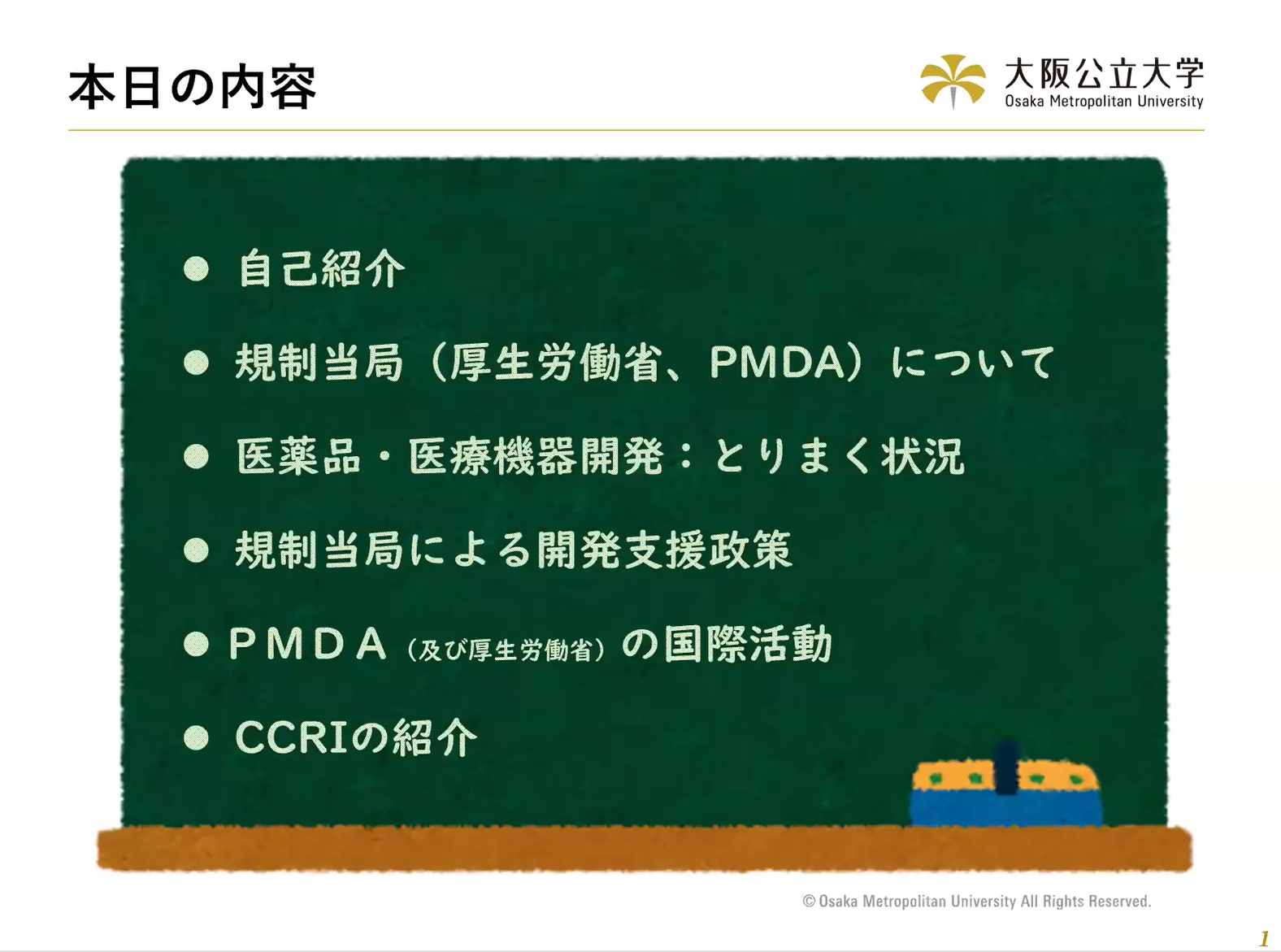
At the beginning of the seminar, he provided an overview of the Ministry of Health, Labour and Welfare (MHLW) and the Pharmaceuticals and Medical Devices Agency (PMDA), followed by an explanation of the current environment surrounding pharmaceutical and medical device development.
He noted that the drug discovery landscape is undergoing significant transformation due to advances in technology, changes in domestic regulatory systems and market conditions, intensifying global competition, and shifts in disease patterns. The global pharmaceutical market continues to expand, driven primarily by growth in the United States and China, alongside the increasing prominence of biopharmaceutical and venture companies. While global pharmaceutical sales have steadily increased overall, this growth is largely attributable to the U.S. and Chinese markets, whereas Japan’s market has remained relatively stagnant.
In the United States, drug development led by startup companies has become increasingly mainstream. By contrast, such activity currently accounts for only about 2% of drug development in Japan. However, Professor Tanaka explained that support systems for venture companies are gradually being put in place in Japan, raising expectations that startup-driven drug development will expand in the coming years.
Professor Tanaka also outlined development support policies implemented by regulatory authorities. To ensure the rapid and stable supply of pharmaceuticals, expert discussions are underway at various levels. In particular, efforts are being made to address issues such as drug lag and drug loss through a review of existing pharmaceutical regulations. As part of these initiatives, the MHLW is actively promoting support measures for venture companies engaged in drug development.
Finally, Professor Tanaka introduced PMDA’s international activities. Against the background of historical differences in regulatory standards and procedures among Europe, the United States, and Japan, the International Council for Harmonisation of Technical Requirements for Pharmaceuticals for Human Use (ICH) was established in 1990. The mission of ICH is to promote global harmonisation in drug development and approval processes, thereby enhancing patient safety and enabling more efficient access to medicines.
Since its establishment, ICH has continued to expand and has grown into an international framework that now includes 23 official members and 41 observer organizations. In addition to multilateral collaboration, PMDA actively promotes bilateral exchanges, with a particular emphasis on strengthening cooperation with countries across Asia.
Following the lecture, a question-and-answer session was held with Dr. Akihiro Watari of the Department of Medical Innovation, Medical Center for Future Medicine, Osaka Metropolitan University Hospital. Professor Tanaka responded carefully and thoroughly to all questions raised by participants.
The next Academia Clinical Development Seminar is scheduled to be held on November 28, and will feature Professor Takeshi Machino of the University of Tsukuba. We look forward to welcoming many participants to the upcoming seminar.